

Msi Mpg Z390 Gaming Pro Carbon
Tom'due south Hardware Verdict
Priced just a bit higher than the board it replaces, MSI's MPG Z390 Gaming Pro Carbon comes with the extra power needed to overclock the Cadre i9-9900K. Those looking for a good balance of performance, affordability and features should have note.
Pros
- +
Good CPU overclocking
- +
Practiced voltage regulator temperatures
- +
Enthusiast-value pricing
Cons
- -
Fewer I/O-panel USB ports than the board it replaces
- -
Mediocre memory overclocking
- -
Poor full-load free energy efficiency
Layout & Features
With a $20 price drib from its $220 MSRP, the now-$200 MPG Z390 Gaming Pro Carbon resembles the Z370 Gaming Pro Carbon it replaces in price equally much as in layout. The reasonable price brings with it an extra fleck of power to support Intel'southward new flagship Cadre i9-9900K processor--and that'south merely enough to equal the value of its moderately-priced predecessor.
Obvious changes from the previous-generation Z370 model include the MPG moniker, which stands for "MSI Performance Gaming," a smaller RGB section on the I/O section'southward top comprehend, and a lower M.2 drive cover that gets more integrated into the blueprint, equally opposed to the Z370 Gaming Pro Carbon'southward standalone cover on the elevation M.2 slot. Less obvious with the MPG Gaming Pro Carbon is the Gen2 front-panel USB 3.1 connector, which gets its 10Gb/s interface from the new Z390 chipset's integrated controller.
Specifications
| Socket | LGA 1151 |
| Chipset | Intel Z390 |
| Form Factor | ATX |
| Voltage Regulator | 11 Phases |
| Video Ports | DisplayPort 1.2, HDMI one.4 |
| USB Ports | 10Gbps: (1) Type-C, (three) Type A 5Gb/s: ✗; (2) USB 2.0 |
| Network Jacks | 1x Gigabit ethernet |
| Audio Jacks | 5x Analog1x Digital out |
| Legacy Ports/Jacks | 1x PS/two |
| Other Ports/Jack | ✗ |
| PCIe x16 | 3x v3.0 (x16/x0/x4, x8/x8/x4) |
| PCIe x8 | ✗ |
| PCIe x4 | ✗ |
| PCIe x1 | 3x v3.0 |
| CrossFire/SLI | 3x / 2x |
| DIMM slots | 4x DDR4 |
| M.ii slots | 2x PCIe 3.0 x4^ / SATA* (*Excludes ports 2, 5, ^5-6 [M.two-2]) |
| U.two Ports | ✗ |
| SATA Ports | 6x 6Gb/southward (SATA M.2s accept pt two, 5, PCIe K.two-2 pts 5-half dozen) |
| USB Headers | 1x 10Gb/s Blazon-C, (two) v3.0, (ii) v2. |
| Fan Headers | 7x 4-Pin |
| Legacy Interfaces | Serial Com PortSystem (beep-code) speaker |
| Other Interfaces | FP-Audio,TPM, (2)RGB-LED, JRainbow RGB, Corsair RGB, Thunderbolt AIC |
| Diagnostics Panel | ✗ |
| Internal Button/Switch | ✗ / ✗ |
| SATA Controllers | Integrated (0/ane/5/10) |
| Ethernet Controllers | WGI219V PHY |
| Wi-Fi / Bluetooth | ✗ |
| USB Controllers | ✗ |
| Hard disk drive Sound Codec | ALC1220 |
| DDL/DTS Connect | ✗ / ✗ |
| Warranty | Three years |
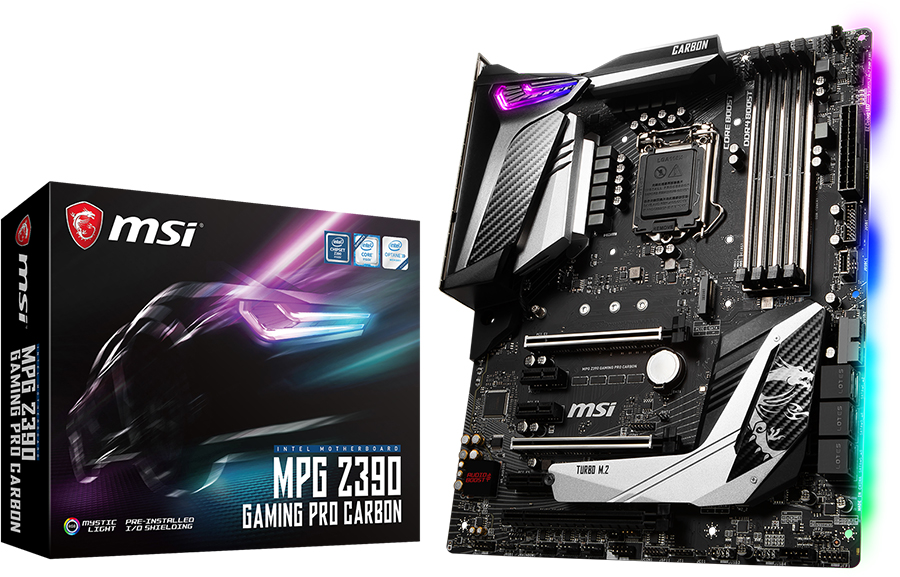
Intel released modified versions of its mainstream chipset IC earlier in 2018 with the H370/B360 launch, and nosotros believe that the Core i9-9900K'due south heftier power requirement was the master reason the company held dorsum its launch of flagship Z390 PCH. That strategy assured that motherboard designers would have aplenty fourth dimension to produce new boards with larger voltage regulators. But finding additional new parts on the MPG Gaming Pro Carbon's pattern required some digging.
Where the Z370 Gaming Pro Carbon had four doubled phases (via parallel MOSFETs) for the CPU core and ii for the integrated graphics (iGPU), the MPG Gaming Pro Carbon has five doubled phases for its CPU core and one for the graphics silicon. That means we're seeing six groups of MOSFETs on each lath. Converting an iGPU phase to a doubled CPU stage required the improver of only i MOSFET and i asphyxiate. Based on stage count alone, the cadre gets 20 percentage more power and the iGPU half as much. MSI said that the iGPU didn't need that much power, and nosotros'd concord that buyers who rarely apply the CPU's integrated GPU are unlikely to overclock it. MSI would likewise like u.s.a. to label the new voltage regulator an 11-stage design. And since its competitors likewise use parallel MOSFETs to double their phase counts, we reluctantly agree.

Compared to the Z370 model it replaces, the MPG Z390 Gaming Pro Carbon upgrades two USB ports to 10Gb/s (from 5Gb/s) and loses 2 5Gb/s ports. The increase in USB iii.i Gen2-spec ports is courtesy the Z390'south integrated controller, and the loss of rear-panel connectors tin can be blamed on the presence of a Gen2 front-panel connector that was missing from the earlier board. Other I/O changes include a factory-installed I/O shield and a bare space between the Gigabit Ethernet port and audio jacks, behind which resides an empty Primal-East/CNVi slot for the -Ac model's Wi-Fi module. If yous want Wi-Fi, the MSI MPG Z390 Gaming Pro Carbon-Air conditioning costs $xx more than than this board, or about $220. DisplayPort and HDMI outputs for integrated video, five analog jacks and one digital optical sound output carry over from the previous-generation MSI model this board is replacing.
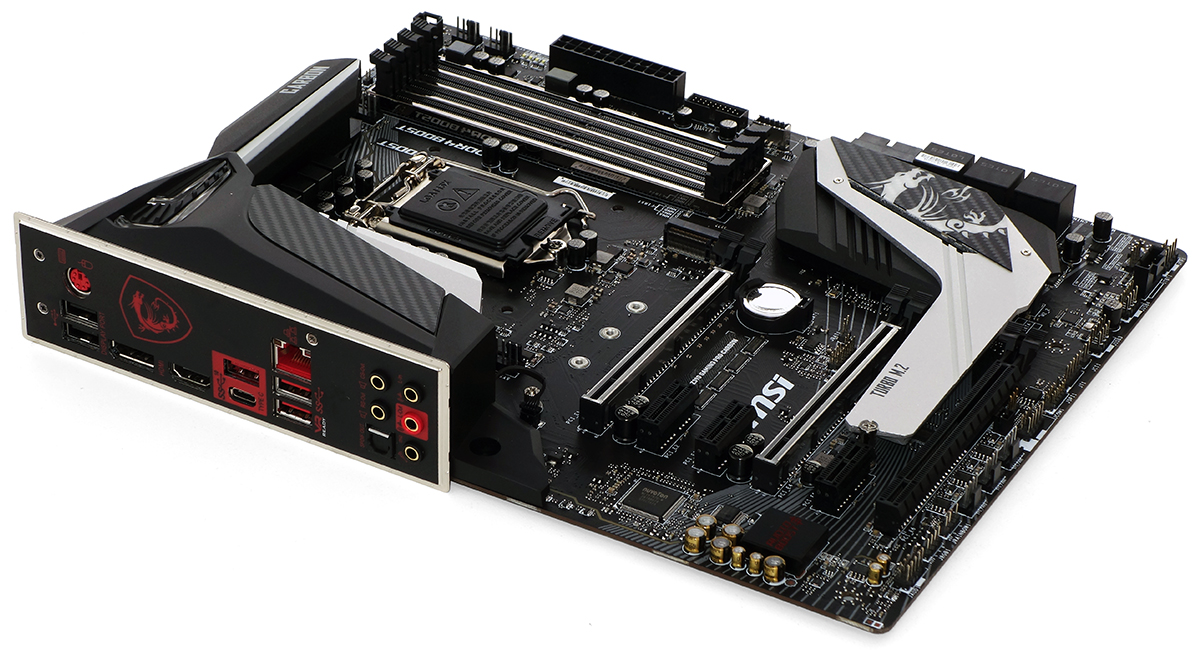
More simply a cosmetic upgrade, the MPG Z390 Gaming Pro Carbon'south new Yard.2 heat spreader design makes sense because the lower Yard.two slot is potentially subject to greater estrus (from the nearby graphics card) than the upper slot (which sits above the first graphics carte du jour slot). Heat for the second Thou.2 slot should only be an issue, though, when installing a 2d graphics card. Notation, though, that calculation a second menu in this x16 slot robs half the CPU-based PCIe lanes from the upper slot (x16/x0 to x8/x8 conversion). Dropping in a third graphics menu is also supported for CrossFireX but not SLI, since the lower x16-length slot gets only four lanes from the chipset. Those who want multi-carte setups with maximum bandwidth volition yet have to await to pricier platforms similar Intel'south X299/Core-Ten or AMD's X399/Threadripper.
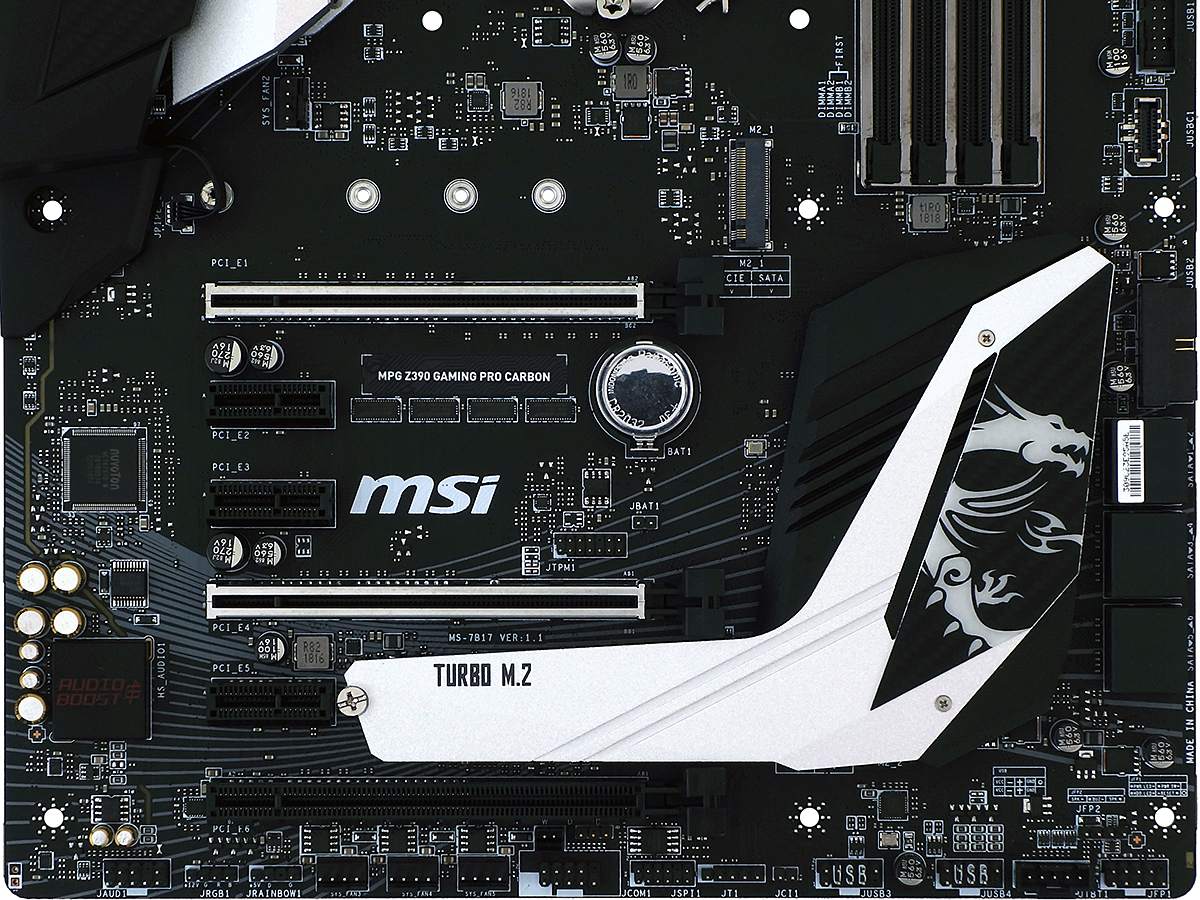
The MPG Z390 Gaming Pro'south lesser edge is packed with headers. Here y'all'll notice front-panel audio, i (of two) standard RGB LED headers, a Jrainbow (digital/addressable) header, three (of seven) PWM fan connectors, a legacy COM port connectedness, chassis intrusion, two dual-port USB 2.0 headers, a Thuderbolt add-in card header, a beep-code speaker connector, and an Intel-standard front-panel LED/button header. The TPM header is mid-board by the RTC battery, and the front-console USB 3.1 Gen2 header is institute between two USB 3.0 headers along the forepart edge. A Corsair (addressable) LED header is found next to the second RGB strip header in the lath'southward upper-front corner, almost 2 more of its fan headers.
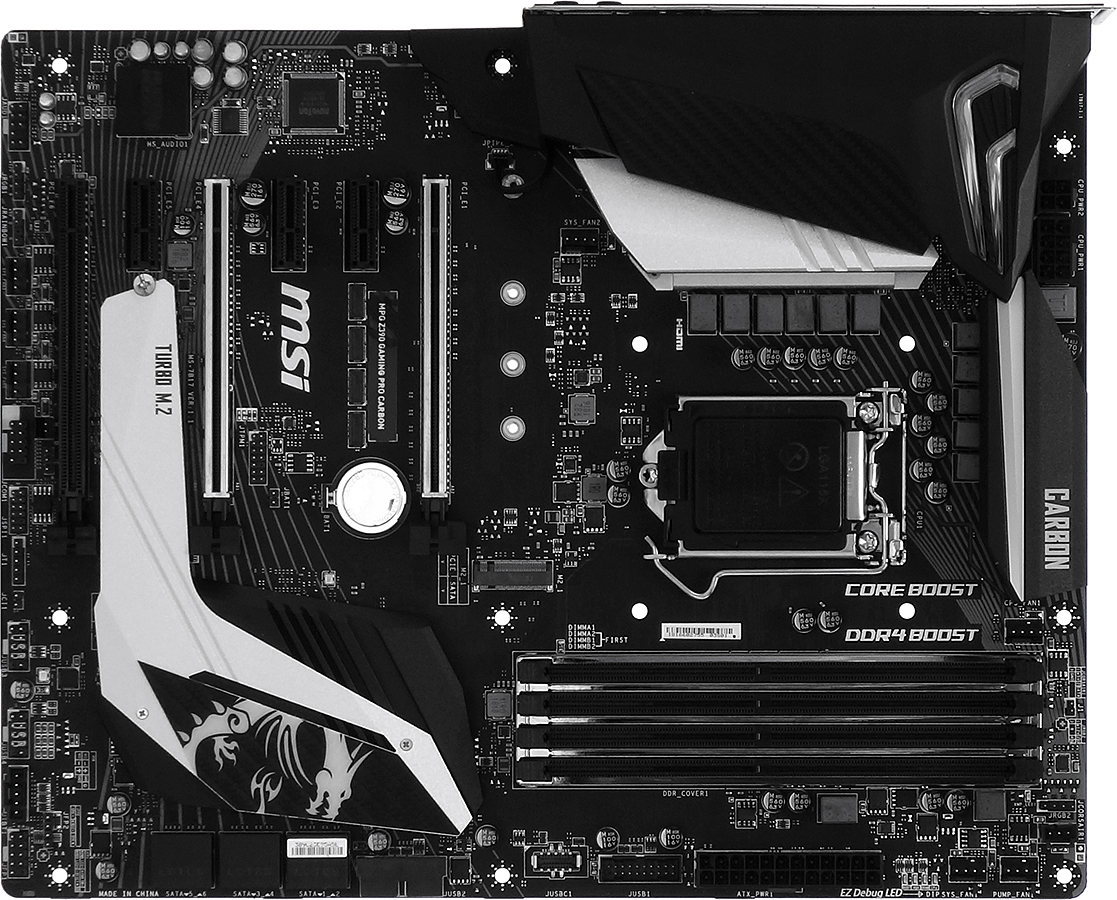
Six SATA ports and one front-panel USB three.0 header face forward to allow the fitment of cards that are longer than the motherboard, and the ii fan headers we didn't mention above are located at the upper-right and lower-left corner of the CPU cooling surface area to ideally fit a traditional CPU cooler and example exhaust fan. We didn't notice any fitment bug overall, apart from the upper PCIe x1 slot being covered past the coolers of virtually graphics cards--and the same issue also applies to the lower x1 slot when two graphics cards are installed. MSI even spaced the two CPU-connected x16-length slots autonomously iii spaces to aid airflow to the graphics coolers. This layout, though, means that placing a graphics card in the third x16-length slot will typically crave the use of an eight-slot example, whereas the ATX standard has only 7 expansion slots.
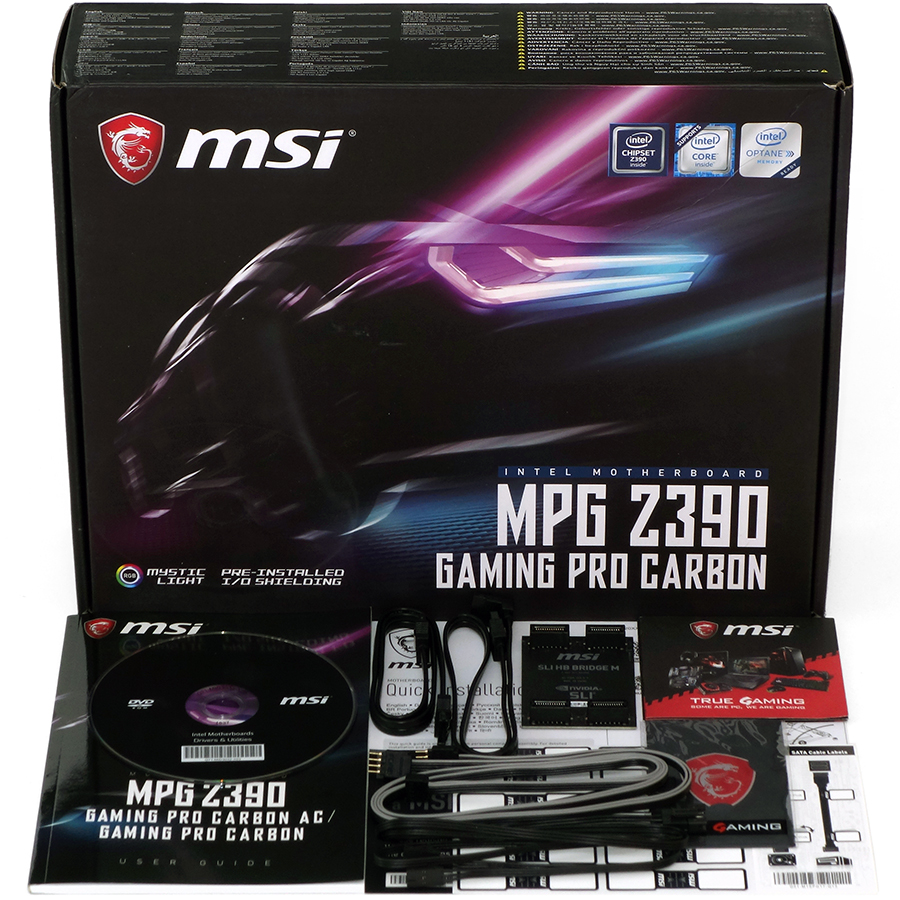
The MPG Z390 Gaming Pro Carbon includes a commuter/app disc and printed documentation, two SATA cables, a high-bandwidth SLI span, an RGB LED splitter cable, Corsair-style addressable LED and JRainbow LED cables, an MSI VIP card, a example badge, and cablevision label stickers.
MORE: Best Motherboards
More: How To Choose A Motherboard
MORE: All Motherboard Content
Source: https://www.tomshardware.com/reviews/msi-mpg-z390-gaming-pro-carbon-9900k-atx-motherboard,5856.html
Posted by: josephphisecome.blogspot.com
0 Response to "Msi Mpg Z390 Gaming Pro Carbon"
Post a Comment